

Mental Health Doesn’t Exist in a Vacuum: How Black History Shapes All of Us
Sara Mathew, MSC Intern
One of the things we know about mental health is that the story matters. Not just the story you tell yourself about who you are, but the larger story you were told about where you come from that includes your family, your community and your country. When that story is full and honest, it gives you context for who you are, why you are the way you are, and where you belong in the larger world.
But what happens when the story is incomplete? What happens when whole chapters have been left out, minimized, or rewritten?
That’s not just an educational problem. It’s a mental health one.

The Erasure of Black History Is a Mental Health Issue
February is Black History Month and every year it seems, there are debates about whether it’s still necessary, whether we’ve moved past it, whether talking about history does more harm than good.
But the reality is, we haven’t talked about it enough. And the cost of that silence shows up in ways we don’t always connect back to its source.
Black history is not abstract. Slavery was not just an economic system — it was the systematic destruction of family, identity, and personhood. Segregation was not just separation — it was the deliberate exclusion from wealth, education, and opportunity. Medical racism was not just bias — it was experimentation, exploitation, and a legacy of distrust that still affects whether Black Americans seek care today. Redlining was not just a housing policy — it was the engineered prevention of generational wealth that whole communities are still recovering from. These were not accidents. They were decisions made by the majority in power that turned into policies and practices. And the consequences did not end when the policies did.
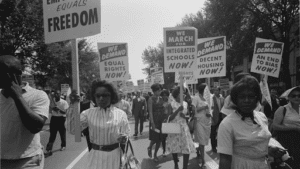
When Black Americans are not given the full context of their history something quietly damaging happens. Struggles that are rooted in systemic harm get internalized as personal failure. Anxiety, depression, chronic stress, and distrust of institutions are not things that just appear from nowhere. They have history. They have context. And when that context is missing, people are left to conclude that something must simply be wrong with them.
This is the present day impact that rewriting history has on the mental health of not only Black Americans but other minority groups who reside in this same system.
Pain without context becomes shame.
There is also a physiological reality here that research has continued to confirm: trauma doesn’t just live in memory. It lives in the body. It gets passed down through families, through nervous systems, through the cumulative stress of navigating a world that has communicated, in small and large ways, that you are less than. Intergenerational trauma is real. We have never fully reckoned with the way racist public policy has shaped this country for two centuries. So it’s no wonder we have never fully dismantled it. You cannot begin to heal what you have never been allowed to name.
But This Isn’t Only Black America’s Loss
And this is where it gets uncomfortable for a lot of people.
The erasure of Black history doesn’t only harm Black communities. It leaves everyone else living in a distorted version of reality and that distortion has its own mental health consequences.
When we don’t understand the full arc of American history, we lose the ability to make sense of the present. We misattribute social problems. We mistake systemic outcomes for individual ones. We look at communities that are struggling and ask “what’s wrong with them?” instead of “what happened here?” That gap in understanding doesn’t just lead to bad policy. It creates barriers to authentic connection that makes genuine community possible.
There is something quietly disorienting about living inside an incomplete story. It creates a false sense of how the world works, and a false sense of what people are capable of or responsible for. And when reality eventually breaks through (and it will through a news cycle, through a relationship, through your own child asking questions you don’t know how to answer) it can feel destabilizing in ways that are hard to name.
We were not taught to connect that disorientation to history. But it’s time we start.
Communities of Color Are Not Outside of This
Communities of color are not exempt from this reckoning either.
Groups have sometimes been positioned against each other in ways that serve none of them. The model minority myth, the idea that some communities “made it” through hard work and assimilation alone, has been used to minimize Black experiences of systemic racism while pressuring other communities of color into silence about their own struggles. It is a narrative designed to divide.
Recognizing how Black history has shaped this country is not about competition. It is about understanding a shared landscape that has affected all of us, in different ways, and that none of us fully escape.
Where the Real Work Starts
So what do we do with this?
The first step is simple, even if it isn’t easy: we sit with whatever we feel — resistance, recognition, grief, guilt, curiosity — and recognize that it is connected to something.
Then we get curious. We read. We listen. We stop putting the burden on Black people to teach us.
We start to understand Black history as the history of this country, which means it has been all of ours, all along.
If this made you uncomfortable, that may be worth paying attention to. Sit with it. Lean into it as much as you can tolerate. And then explore why.
Here are some questions to consider:
- What is the discomfort connected to?
- What story were you given?
- What were you never taught?
This is where the real work begins, and it’s work you don’t have to do alone. Understanding how history, identity, and systems have shaped you is not something you have to figure out in isolation. It’s exactly the kind of work that benefits from having a professional who can sit with you in it, someone who understands that healing doesn’t happen in a vacuum any more than mental health does. If you’re ready to explore that, our therapists at Mindful Springs are here to support you on your journey of becoming the best version of yourself

History is not the past. It is the ground we are standing on right now. And the more clearly we can see it, the more clearly we can see ourselves and each other.
Want to start now? Here’s where to begin.
Books to consider reading:
- Why Are All the Black Kids Sitting Together in the Cafeteria, by Beverly Daniel Tatum — Explores how racial identity develops and why we self-segregate.
- / I’m Still Here: Black Dignity in a World Made for Whiteness by Austin Channing Brown — A powerful memoir about what it means to be Black in predominantly white spaces
- The New Jim Crow by Michelle Alexander — How mass incarceration has functioned as a system of racial control.
- Between the World and Me by Ta-Nehisi Coates — Written as a letter to his son, one of the most personal accounts of what it means to live in a Black body in America.
- My Grandmother’s Hands by Resmaa Menakem — Explores how racial trauma lives in the body and offers practices for healing.
Podcasts worth a listen:
- 1619 Project (New York Times) — Reframes American history by placing the legacy of slavery at the center of the national story.
- Code Switch (NPR) — Honest, accessible conversations about race and identity and how they show up in everyday life.
- Seeing White (Scene on Radio) — A deep dive into the history of whiteness in America. Uncomfortable in the best way.
Places to add to your travel list:
- National Museum of African American History and Culture (Washington D.C.) — The most comprehensive museum dedicated to Black American history and culture. Worth planning a trip around.
- The Legacy Museum (Montgomery, Alabama) — Created by the Equal Justice Initiative, it traces the history of slavery, lynching, and mass incarceration in America. Profound and necessary.
- The National Civil Rights Museum (Memphis, Tennessee) — Built around the Lorraine Motel where Dr. Martin Luther King Jr. was assassinated. Walks you through the full arc of the civil rights movement.
- The African American Museum of Philadelphia — The first institution funded by a major American city to preserve Black history and culture.
Resources for further exploration:
- Equal Justice Initiative (eji.org) — Bryan Stevenson’s organization. Extensive historical resources, reports, and documentation on racial injustice in America.
- Smithsonian National Museum of African American History and Culture (nmaahc.si.edu) — Even if you can’t visit in person, the online collections and digital resources are extensive.
- Teaching Tolerance / Learning for Justice (learningforjustice.org) — Resources for understanding race, identity, and systemic issues. Accessible for all ages.
Mindful Springs Counseling is a nationwide mental health center specializing in non-traditional therapy services like Brainspotting and Ketamine-Assisted Psychotherapy and 100% independently owned by Aimee Solis, Founder and Executive Director. Mindful Springs has locations in Colorado, Washington and Illinois.